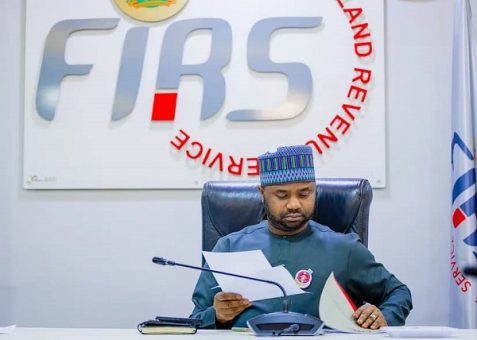
A pro-revenue advocacy group, alongside several civil society voices under the umbrella of the Forum for Economic Recovery and Development (FERD), has defended the Executive Chairman of the Federal Inland Revenue Service (FIRS), Dr. Zacch Adedeji, over criticisms trailing a recently signed Memorandum of Understanding (MoU) between the FIRS and France’s Direction Générale des Finances Publiques (DGFiP).
In a statement issued on Tuesday and made available to journalists, the group described calls for Dr. Adedeji’s suspension over the MoU as “baseless, malicious and politically sponsored,” warning that such attacks were aimed at undermining ongoing tax administration reforms that have contributed to improved revenue collection.
The statement, signed by FERD’s President, Dr. Ibrahim Mohammed, said critics of the agreement had failed to present any verifiable evidence to support claims that the MoU would hand over control of Nigerian taxpayers’ data to France.
According to the group, the pact, signed on December 10, 2025, is a technical assistance and capacity-building arrangement designed to modernise Nigeria’s tax administration through the exchange of expertise in digital tax tools, automated compliance systems and data analytics.
“We must have trust in our public institutions,” the statement said. “The FIRS has clearly stated that the MoU does not grant France access to Nigerian taxpayer databases, digital systems or operational infrastructure. Existing Nigerian data protection and cybersecurity laws remain fully applicable, and these assurances should be accepted until proven otherwise.”
FERD expressed concern that, despite these assurances, several political parties, regional groups and civil society organisations had continued to criticise the agreement, arguing that it could threaten national sovereignty and expose sensitive economic data.
The group noted that recent public statements by the FIRS had emphasised that the collaboration is a non-executive, advisory arrangement focused on skills transfer, adding that the agency would continue to work with Nigerian technology firms and payment processors within a multi-channel revenue collection framework.
“Independent tax policy experts would ordinarily not oppose technical cooperation with advanced tax authorities if it can accelerate modernisation,” the statement added. “However, we urge the government to remain transparent about the scope of data sharing, the safeguards in place, and the procurement and oversight mechanisms that will protect Nigerians’ information.
“However, we gathered that the controversy has begun to attract the attention of lawmakers and opposition parties, with some calling for the MoU to be presented before the National Assembly or for a comprehensive public briefing on its terms.
We therefore suggest that the FIRS and the Federal Government may need to move swiftly to provide clearer details on legal safeguards, data-handling protocols and the role, if any, that foreign agencies or vendors will play in Nigeria’s future revenue collection systems.
The group concluded that the handling of the issue will be critical to shaping public confidence in Nigeria’s digital tax transformation and the credibility of the reforms being pursued by the FIRS under Dr. Adedeji’s leadership.

 Middle-Belt Times